Duong Dong Night Market Local Tips — What Locals Eat (and Don't Order) in Phu Quoc
The duong dong night market local tips that actually matter are not about which stalls have the longest queues — tourist crowds are a terrible guide here. After eight years living 600 metres from Cho Dem Dinh Cau and walking there more evenings than I can count, I know the corn vendors who grill to order, the two squid stalls that use real sim-berry sauce, which end of the market is still alive at 10 PM, and the things I quietly steer guests away from. This is the version I give people on their first night.
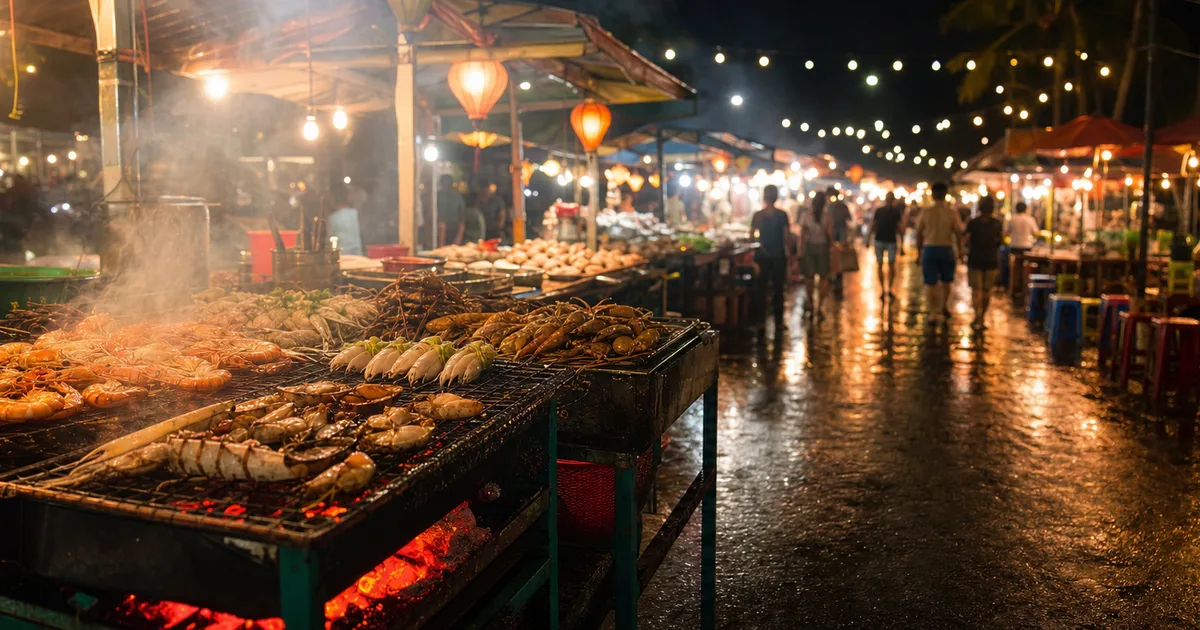
Full stock, fresh charcoal, still-bright sky fading to lanterns.
Southern inland rows stay open. Seafood selection thins but snacks are fine.
Scallops, squid, rice, two coconuts, two beers — the local round.
600 m down Nguyen Du then left on Bach Dang. No motorbike needed.
What locals actually order at Duong Dong Night Market
Most guests arrive expecting to see what they read about online — scallops with spring onion oil, tiger prawns by the 100g, whole grilled squid. Those are real and worth ordering. But they are the front row, and locals tend to eat a different way.
The first thing is that Phu Quoc residents rarely make a full sitting-down dinner out of the market. They come for one or two specific things, eat standing or on a plastic stool at the side, and leave in twenty minutes. It is more like a snack circuit than a restaurant. If you go in the same way — decide what you want before you start walking, get a coconut, do not linger at the tourist rows — you eat better and spend less.
What I personally eat when I go, which is maybe two or three times a week: grilled corn from the vendor halfway down the central aisle, a portion of squid from the stall that does the sim-berry sauce (more on that below), and sometimes a glass of fresh sugarcane juice on the way out. Total: maybe 80,000–100,000 VND. The market is 600 metres from the homestay, so it is not an expedition — it is just dinner.
For guests staying in my rooms, I always draw the route on their maps app before their first visit. Takes thirty seconds and saves them twenty minutes of wandering.
The dishes locals eat vs. what the seafood rows are selling
The front seafood stalls — the ones with bright lights and laminated English menus — are not bad. The seafood is genuinely fresh, the grilled scallops are excellent, and prices are fair if you confirm them first. But the market is larger than the tourist strip suggests. The interior rows running south from the main entrance have snack vendors, grilled meats, fresh juice carts, dried goods, and the corn stalls. Locals shop these rows; tourists often miss them entirely.
The sim-berry squid — and how to find the right stall
This is the thing I mention most when guests ask what to try. Phu Quoc-style grilled squid (mực nướng) with sim-berry sauce is not a standard menu item — most tourist-facing stalls serve squid with plain chili lime dipping sauce, which is fine but generic. The sim-berry version is specific to this island, and it is genuinely different.
Sim berries (trái sim) are small wild fruit from the forests in the island's interior — the same berry used to make ruou sim, the local wine. You reduce them with chili, garlic, and a little sugar and end up with a dark purple-red sauce, sweet-tart, not jammy. On charcoal-grilled squid it works well: the acidity cuts the char, and the fruit sweetness picks up the squid's natural brine. The plain chili-lime version most stalls use just sharpens everything without adding anything back.
There are two stalls I know of that serve this consistently. Both are in the central section of the market, not on the main seafood row facing Bach Dang street. You will find them by smell — the squid goes on whole, gets scored, and the sauce caramelizes on the grill. The stalls have no English signage. Point at the squid, hold up one finger. They understand. A medium whole squid with sauce: 90,000–110,000 VND in 2026. Confirm before it hits the grill.
If you want to read more about sim wine and the sim berry itself, the Phu Quoc food guide covers it in detail — the wine section near the bottom.
Grilled corn — the most overlooked stall in the market
Bắp nướng. Grilled corn. I have no idea why this gets skipped by visitors but it does, consistently.
The cobs are grilled over charcoal low and slow, brushed repeatedly with a mix of butter and rendered pork fat during cooking, and finished with a sprinkle of salt and dried chili. The result is caramelized, slightly smoky, deeply savory in a way that corn roasted in a gas oven never achieves. It takes 4–5 minutes per cob. 15,000–20,000 VND.
The vendor I go to is in the middle section of the market, second row in from the main seafood strip. She is usually there by 5:30 PM and sells out by around 9:30 PM. Maybe 80–90 cobs a night, mostly locals and a few Vietnamese tourists who know to look. Buy one to eat while you walk. If you go back for a second, she'll remember your face.
It is not exotic. It is not Phu Quoc-specific in the way that sim wine is. But it is one of those things that makes a good evening at the market feel complete, and it costs almost nothing.
What to skip — and the specific things to watch for
Most guests eat here without any trouble. A few things are worth knowing before you go in.
Pre-plated seafood trays at the front entrance
Some stalls near the Bach Dang entrance display pre-arranged trays of seafood — a few prawns, some scallops, squid — already prepped and sitting out unwrapped. These exist for walk-by tourists who want to grab something fast. The problem is you have no idea how long the tray has been sitting out at tropical air temperature. At stalls further in, the seafood comes straight from a live tank or cold box and goes on the grill. That is a different thing entirely.
Lobster without confirmed tank origin
A small number of stalls sell lobster at prices that look reasonable — 300,000–500,000 VND for a small one. At genuine live-tank prices, that would be very cheap. If a vendor cannot show you the live tank the lobster came from, it is probably previously frozen. Not dangerous, but not what you are paying for. The food guide has a full seafood price table if you want reference numbers before you go.
Unconfirmed pricing on anything sold by weight
This applies everywhere on the island, not just here. Any seafood sold by the kilogram — prawns, crab, larger fish — needs a weight confirmation before it goes on the grill. Most stalls are honest. Some are not. Ask to see the scale reading. A good stall will not mind; a difficult stall is a stall to leave.
There is more detail on the FAQ page about price checking and general night market navigation if you want it.
Timing: when to arrive, and which end closes last
The market runs from approximately 5:00 PM to 10:30–11:00 PM daily. But it does not close evenly — there is a geography to when things wind down.
The northern end, near the Dinh Cau rock and the lighthouse area, is the most photogenic and the most tourist-facing. It also closes earliest. By 10:00 PM most stalls on that end are already packing ice and rolling carts away. The seafood selection there is at its best from 5:30 PM to 8:30 PM.
The southern and inland rows — the ones running away from the waterfront — stay active until 10:30 PM or slightly later. These are the rows with the corn vendors, grilled meat stalls, fresh juice carts, and the sim-berry squid stalls. If you arrive after 9 PM, this is where you want to be.
My honest recommendation: 6:00 PM to 7:30 PM. The charcoal is freshly lit so everything grills faster, the full seafood stock is still there, and the sky is still doing something good — golden hour fading into the first lanterns. Much after 7:30 it starts to fill up and navigation slows. If you are coming from further away on the island, check the transport guide for Grab timing — Grab can be slow to dispatch between 5:30 and 7:00 PM when everyone is heading out for dinner.
What about the market on rainy evenings?
It runs in light rain. Vendors have covers and most of the interior rows are partly sheltered. In heavy rain — the kind that comes in fast during the May–October wet season — some outdoor stalls pack up early, but the permanent indoor section stays open. The market runs year-round without official closure days. Wet season evenings (June–September) are actually good: the rain breaks the heat, and the market is noticeably less crowded than peak December–February.
Night market prices — 2026 reference table
These are the ranges I have seen consistently in 2026. Individual stalls vary; confirm before ordering anything sold by weight.
| Item | VND | USD approx. | Notes |
|---|---|---|---|
| Grilled corn (bắp nướng) | 15,000–20,000 | $0.60–$0.80 | Central aisle, 4–5 min grill time |
| Grilled squid with sim-berry sauce | 90,000–110,000 | $3.60–$4.40 | Medium whole squid; confirm before grill |
| Grilled scallops (so diep nuong) | 10,000–15,000 each | $0.40–$0.60 | Spring onion + peanut; order 6+ minimum |
| Tiger prawns (per 100g) | 250,000–400,000 | $10–$16 | Confirm weight before cooking |
| Oysters, garlic butter (each) | 20,000–30,000 | $0.80–$1.20 | Freshest Oct–Mar |
| Fried rice (com chien) | 40,000–60,000 | $1.60–$2.40 | Serves 1–2; essential accompaniment |
| Fresh coconut | 15,000–25,000 | $0.60–$1 | Standing carts, not seafood stalls |
| Sim wine by the glass | 15,000–20,000 | $0.60–$0.80 | Taste before buying a bottle |
| Sugarcane juice (nuoc mia) | 10,000–20,000 | $0.40–$0.80 | Pressed to order; exit-row carts |
| Local beer (Saigon 333, can) | 20,000–30,000 | $0.80–$1.20 | Sold at seafood tables and drink carts |
Prices as of July 2026. Wet season (May–October) does not meaningfully affect night market pricing. Seasonal items like sea urchin (nhum) are cheapest and most available November–March.
For context on how the night market compares to full seafood restaurants and what a complete food budget for the island looks like, the Phu Quoc food guide has a breakdown by budget tier.
Getting to the market from Sabrina Homestay
The homestay is at 16 Nguyen Du, Duong Dong — about 600 metres from the market entrance on Bach Dang street. On foot, walking south on Nguyen Du then turning left, it takes 7–8 minutes. There is no need for a motorbike or Grab for the market; the walk is flat, well-lit from about 6 PM onward, and passes a few small shops if you need cash or water before you go in.
If you are arriving from elsewhere on the island — a beach day at Bai Sao, a trip to Vinpearl, a day out north — the transport guide covers Grab pricing and timing in detail. Budget 15,000–35,000 VND for a Grab from most points in Duong Dong to the market entrance.
Motorbike parking is available on Bach Dang street for free. On busy evenings (weekends, peak season December–February) it fills up early. If you ride here, park before 6 PM or expect a longer walk from a side street.
The location page has a map with the exact walking route marked. I added it after the third guest in one week got turned around on the back streets.
A note on booking if you are planning around the market: wet season evenings are genuinely underrated — fewer tourists, the same food, occasionally a spectacular pre-rain sunset over the Dinh Cau rock. Rooms are also meaningfully cheaper May through September. See the FAQ for seasonal pricing questions.
Stay 7 Minutes from the Market
Sabrina Homestay is on Nguyen Du street, Duong Dong — a flat 7-minute walk from Cho Dem Dinh Cau. I walk guests there on their first evening. From $12/night.
WhatsApp Us →