Coffee Shop Duong Dong Phu Quoc Local — Where Regulars Actually Go
Most guests who ask me about coffee on Phu Quoc are picturing a café with a view of the sea and 80,000 VND cortados. That exists. I never go there. What I actually do most mornings is walk eight minutes to a garden tucked behind the market where the same group of retired fishermen and school teachers shows up before 7:30, orders one cup each, and sits until 9:30. Nobody rushes. The coffee costs 30,000 VND. This guide is about those places — the independent coffee shops within roughly 1 km of Duong Dong town centre that locals use, including what to order, what it costs, and which ones are worth going out of your way for.
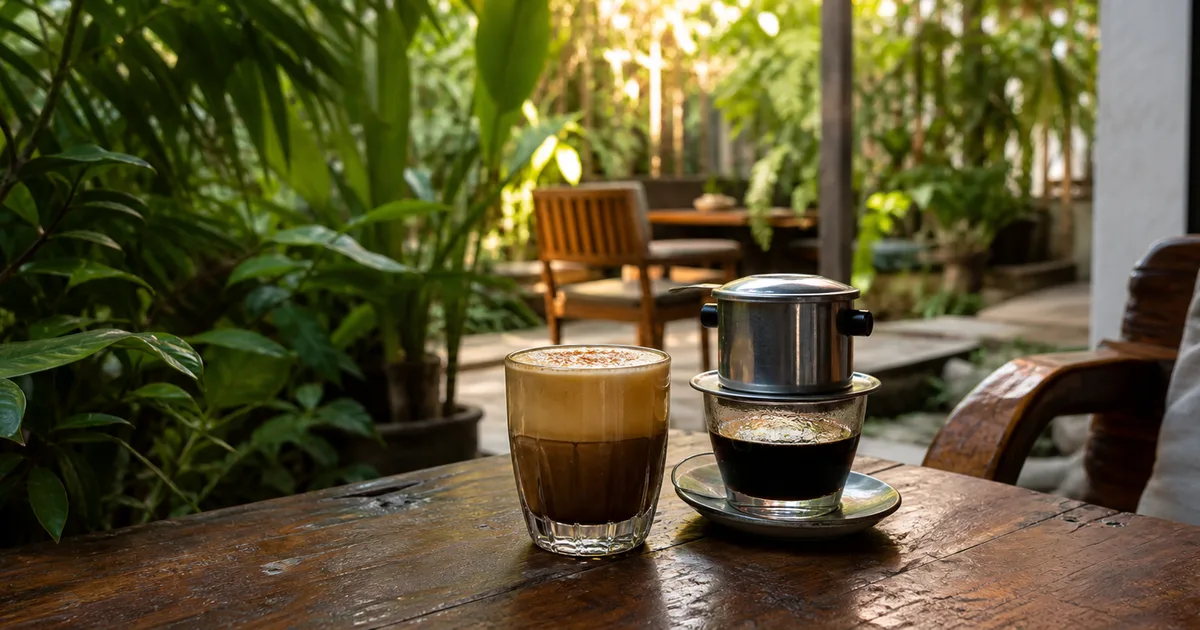
Ca phe sua da to go. Done in two minutes. Probably the best ratio of quality to price on the island.
Sit for two hours over one cup. No Wi-Fi, no rush, regulars only attitude (you're welcome anyway).
Thick whipped egg yolk foam over hot robusta. Closer to dessert than a drink. Order it once.
Local robusta brewed slowly. Not trying to be Hanoi specialty coffee. Better for that.
Street-stall coffee before 8 AM — and why I usually start there
On Nguyen Du street, about 80 m from the homestay gate, there is a cart that opens at 5:45 AM. The woman running it has been there since before I moved to this street. She fills a phin filter with dark-roasted robusta, sets it over a glass of condensed milk, and hands it to you. Ca phe sua da, 20,000 VND. You can stand there or take it to the concrete bench across the lane.
This is how most of Duong Dong actually drinks coffee. Not at a café with playlists and menu boards. At a cart, early, before the day gets complicated. The coffee is strong — robusta runs roughly twice the caffeine of arabica — and the condensed milk cuts the bitterness cleanly. Three minutes start to finish.
Street stalls cluster within 200–400 m of the Duong Dong market in every direction. Most open between 5:30 and 6:30 AM and close by 10:00 AM when the breakfast rush ends. Price range: 15,000–25,000 VND for ca phe sua da (iced milk coffee), 12,000–18,000 VND for ca phe den (black, no milk). Some also sell banh mi and hu tieu from the same folding table, which makes the logic of stopping there for 20 minutes obvious.
The garden café behind the market — my regular spot
I found this place in my second year on the island. Someone at the market told me to turn down a narrow lane off Bach Dang street, past the motorcycle repair workshop, through a gate that has no sign. Inside: four or five wooden tables under mango and banana trees, a cat sleeping on one of the chairs, and a woman in her sixties who has been making coffee here longer than I have been on Phu Quoc.
It is roughly 300 m from the main market entrance, about a 4-minute walk. There is no sign at all. The lane off Bach Dang is easy to miss. The gate looks like a private house gate, because it basically is.
She makes ca phe trung (egg coffee) here — the Hanoi original, thick egg yolk foam spooned over hot robusta, 35,000 VND — but honestly I usually just order the iced black coffee and sit there until the mango tree starts getting loud with birds. Ca phe den da: 25,000 VND. The regulars I keep seeing include a retired teacher who reads a newspaper (printed, actual paper), a man who I am fairly sure runs one of the fish sauce warehouses near the harbour, and occasionally a young woman with a laptop who seems to work for about 25 minutes and then gives up because there is no Wi-Fi.
Hours are approximately 7:00 AM to 2:00 PM, sometimes shorter. No phone number. It closes when the owner feels like it, which is the correct policy. Go before 9:00 AM if you want a table.
Where to get egg coffee (ca phe trung) in Duong Dong
Ca phe trung started in Hanoi in the 1940s — a workaround during a milk shortage, using egg yolk and sugar to approximate the richness people wanted. The technique spread slowly down Vietnam and now shows up on menus across the country, including Phu Quoc.
It is not a latte. It is not sweet in the way a dessert coffee from a chain is sweet. Whisked egg yolk, sugar, and a small amount of condensed milk form a thick pale foam that sits on top of a small cup of very strong, very hot robusta coffee. You can eat the foam with a spoon before it sinks, or stir it in, or let it slowly dissolve. The whole cup is about 100 ml. Price in Duong Dong: 30,000–45,000 VND.
The garden café behind the market does it well. A couple of the smaller independent places on the Tran Hung Dao side streets also serve it; quality varies, and a few get the egg-to-coffee ratio wrong in a way that makes it unpleasantly dense. The garden café version is more restrained — the foam is thicker than whipped cream but not so heavy it cancels the coffee underneath.
Ca phe trung is always served hot. If you want cold, that is a separate thing — a few cafés do a chilled version layered over ice, closer in texture to an egg-nog iced coffee. Worth trying once, but the warm version is the real one.
Coconut coffee (ca phe cot dua) — where to find it
Coconut coffee originated in Hoi An, not on Phu Quoc, but it has arrived on the island and suits the climate well. Strong Vietnamese drip coffee, coconut cream, ice. Sometimes blended smooth, sometimes layered so the cream floats on top. Sometimes served in a half-coconut shell, which is theatre more than function but I do not hold it against anyone.
Two or three cafés on the streets immediately off Tran Hung Dao in central Duong Dong have it on the menu, mostly aimed at younger Vietnamese tourists from Ho Chi Minh City who drive up for the weekend. Price: 40,000–55,000 VND. The quality is consistent enough. Order it before 11:00 AM when the coconut cream is fresh from that morning's preparation rather than something that has been sitting in a fridge since yesterday.
The version I prefer uses slightly less sugar than most recipes call for, which lets the actual coconut flavour come through. If yours arrives very sweet, that is not wrong — it is just the standard Vietnamese preparation. You can ask for it with less condensed milk (it cuong sua con) and most places will oblige.
Locally grown robusta pour-over — what it actually is
Phu Quoc grows coffee. Not much of it, not in the quantities that the Central Highlands produce, but farms in the island's interior — roughly 15–20 km from Duong Dong toward Cua Duong — cultivate robusta on red laterite soil. A few small-batch roasters on the island now buy from these farms and sell through local cafés.
It is robusta, not arabica. People who have learned to drink coffee through specialty-coffee culture sometimes resist this. Robusta has more body, more bitterness, less acidity, and about double the caffeine. It is not inferior to arabica; it is different. A properly grown and roasted Phu Quoc robusta brewed slowly through a phin filter or a simple pour-over setup is earthy, dark, slightly chocolatey, and very direct. No fruit notes, no florals. Just coffee, loudly.
To find it, ask specifically for ca phe Phu Quoc or ca phe robusta noi dia (local robusta). Not every café labels it, and several places selling "Phu Quoc coffee" are using mainland beans in a Phu Quoc-branded bag. The cafés that source genuinely local beans tend to mention the farm or the roaster; if there is no information offered, it is probably not local. Price for a pour-over or phin-brewed local robusta: 45,000–60,000 VND.
The Tran Hung Dao strip cafés — what to expect
Tran Hung Dao is the main road running through Duong Dong, and the side streets immediately adjacent to it have the highest concentration of independent cafés within easy walking distance of the homestay. Most are a 5–8 minute walk from Nguyen Du street: roughly 400–600 m depending on which street you turn down.
These places sit between local stall and tourist café on the spectrum. They have menus, sometimes in English, they play music, and they keep the tables wiped. A few have decent outdoor seating. They are not trying to be a Hanoi specialty coffee bar. They serve ca phe sua da, ca phe den, ca phe trung, fruit teas, and coconut water, and they do it reliably. Prices: 25,000–55,000 VND depending on what you order.
The thing to know is that on weekend afternoons, when Vietnamese tourists from the mainland come in for short stays, these places fill up fast. Go before 9:00 AM or after 3:00 PM if you want to sit without waiting. On weekday mornings they are quiet enough that you can spend an hour there without feeling like you are occupying a table someone needs.
Some guests ask me which one to go to. Honestly: walk down Bach Dang or Nguyen Trai and stop at the first one that looks occupied by locals rather than by other tourists. That is a reliable filter. If there are five motorcycles parked outside and two people reading phones in Vietnamese, you are in the right place.
Coffee price comparison — Duong Dong 2026
| Drink | Street stall | Local café | Tourist café | Notes |
|---|---|---|---|---|
| Ca phe sua da (iced milk coffee) | 15,000–20,000 | 25,000–35,000 | 55,000–80,000 | VND; skip the tourist price |
| Ca phe den da (black iced) | 12,000–18,000 | 20,000–30,000 | 45,000–70,000 | Stronger than it looks |
| Ca phe trung (egg coffee) | — | 30,000–45,000 | 55,000–90,000 | Garden café: 35,000 VND |
| Ca phe cot dua (coconut coffee) | — | 40,000–55,000 | 65,000–100,000 | Ask for fresh coconut cream |
| Robusta pour-over (local) | — | 45,000–60,000 | 70,000–110,000 | Ask for ca phe Phu Quoc |
| Tra da (iced tea, plain) | free–10,000 | free–15,000 | 20,000–30,000 | Often complimentary with coffee |
| Nuoc chanh da (iced lime juice) | 15,000–20,000 | 20,000–35,000 | 40,000–60,000 | Good caffeine-free alternative |
Prices are July 2026 observations in Duong Dong town. All prices in VND.
One practical thing: most local cafés in Duong Dong do not charge for refills of tra da (plain iced green tea). It arrives at the table automatically when you sit down, cold in a glass pitcher. Drink it. It is one of the small reliefs of a hot morning in a tropical town, and it is genuinely good tea.
If you are used to ordering coffee by the cup and paying when it arrives, the local system is slightly different. You order, you sit, you pay when you leave. Nobody will come to collect mid-session. This is normal. It is also why the garden café regulars can nurse one cup for two hours without anyone noticing or caring.
Staying near the market — 7-minute walk to coffee
Sabrina Homestay sits on Nguyen Du, within easy walking distance of every café in this guide. Rooms from $12/night. The shared kitchen has a kettle and French press if you want to start before the town wakes up.
WhatsApp Us →