Bring small bills (10,000–20,000 VND notes) and a reusable bag
Fish, tropical fruit, fresh herbs, eggs, tofu — all cheaper than any supermarket
Breakfast stalls inside serve bun bo, banh mi, and banh cuon from 20,000 VND
Say “bao nhieu?” (how much?) — even the attempt changes the price conversation
Why Is 6 AM the Right Time to Go?
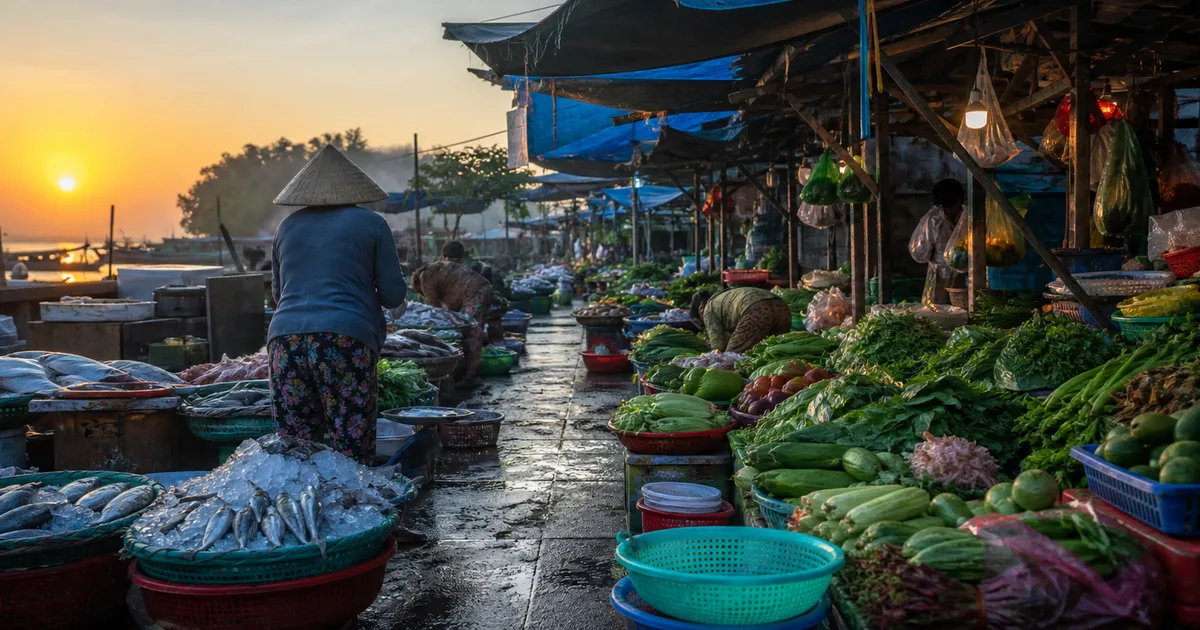
I go to this market probably four mornings a week. Not always to buy much — sometimes just for a bowl of bun bo and to see what came in on the overnight boats. The reason 6 AM works so well is specific: the fishing boats from the south of the island unload between 3 and 5 AM, and by 5:30 AM the fish vendors have had time to clean and sort everything. You get first pick. By 9 AM the good whole snapper is gone, the mackerel selection is half what it was, and the herb vendors are starting to pack up the wilted stuff they couldn’t sell.
There’s also the light. At 6 AM in Phu Quoc the sun is just clearing the palm trees to the east, the air is genuinely cool (25–26°C rather than the 33°C of midday), and the covered fish hall has this amber, slightly smoky quality to it from the vendors who’ve been there since before dawn. By 10 AM it’s just a hot market. At 6 AM it’s something else. If you’re the type who finds markets atmospheric, staying this close to Duong Dong matters.
One practical note: don’t eat first. The breakfast stalls at the market are genuinely good, and if you arrive already full from your room’s instant coffee and a packaged biscuit, you’ll regret it. Go hungry, buy your fish or fruit, then sit down at one of the plastic-stool stalls near the back of the market for a proper breakfast.
How Do You Get to Duong Dong Market from the Homestay?
On foot is the obvious way. From the Nguyen Du area where Sabrina Homestay sits, it’s roughly 400–500 m to the market — you’ll hit Bach Dang street and then follow your nose (and ears) north. The whole walk takes five or six minutes at a relaxed pace. I’ve never once taken a motorbike for this; parking near the market at 6 AM is genuinely chaotic because delivery trucks are still pulling in and out.
The market is split between an indoor covered hall (where the fish and meat vendors are) and the outdoor section that spills along the surrounding streets. The covered hall is the louder, more pungent part and probably the section most worth seeing once, even if you never intend to buy fish. The outdoor section along the street to the east is where the fruit and vegetable vendors are — those are the stalls I use most.
What Is Actually Sold at Duong Dong Morning Market?
The fish section dominates. Whole fish laid out on ice or in shallow trays: red snapper (ca hong), barracuda, mackerel, grouper, pompano. Smaller catches sorted into buckets of squid and various shellfish. Whole crabs, mud crabs especially, tied with raffia and stacked in baskets. Prawns of three or four different sizes, separated. There’s a section for dried and salted fish — important for local cooking and also a legitimate souvenir option, though you should confirm customs rules for your home country before packing dried seafood.
Past the fish hall, the vegetable section has what you’d expect and some things you might not: morning glory (rau muong), long beans, bitter gourd, fresh turmeric root (very cheap, very fragrant), lemongrass stalks, kaffir lime leaves, and chili plants of varying heat. There’s usually one or two women sitting on low stools with big baskets of fresh herbs — Thai basil, Vietnamese perilla, coriander — selling loose bunches for 5,000–10,000 VND. I buy those every time I go, regardless of what else I need. You can’t get herbs that fresh anywhere else on the island at that price. See the full food guide for how to use them.
The fruit section runs along the outside of the covered hall. Rambutan stacked in red-and-green pyramids, mangosteen (seasonal, and when it’s in season it’s the best thing in the market), dragon fruit, pineapple trimmed and ready to eat, green mango sold in bags with a small pouch of chili salt. There’s a woman who I’ve been buying coconuts from for two years now — she sits at the corner near the entrance, always in a blue hat, and if you buy from her she’ll cut the top off with one stroke of a machete and hand it to you with a straw before you’ve finished paying. One coconut: 15,000–20,000 VND. It is, genuinely, the best possible start to a Phu Quoc morning.
There’s also a dry goods section — bags of rice, dried noodles, local fish sauce (nuoc mam Phu Quoc in various grades), dried shrimp, spice mixes — and a small section selling live chickens and eggs. If you’re using the homestay kitchen, the eggs here at 4,000–5,000 VND each are noticeably better than supermarket eggs.
Where Should You Eat Breakfast at the Market?
Inside the covered hall, on the side nearest the street, there are four or five permanent breakfast stalls. They open by 5:00 AM, sometimes earlier, and serve until they run out — usually by 9:30 or 10:00 AM.
The most reliable thing to order: bun bo (beef noodle soup). Not the elaborate Hue version, but the simplified southern variant — thin rice vermicelli, sliced beef, a clear broth with lemongrass and a little chili oil. A bowl is around 40,000–50,000 VND. It arrives in 90 seconds and you eat it at a shared plastic table while vendors on either side of you do the same thing. This is my personal regular order — I’ve had it so many times I don’t even look at the menu anymore.
Also worth trying: banh cuon (steamed rice rolls) with minced pork and wood-ear mushroom, served with a bowl of sweetened fish sauce dipping broth and a handful of fried shallots on top. Soft, delicate, and done well here. About 35,000–45,000 VND for a generous plate. The stall that does these is second from the left as you come in from the main street entrance — the one with the bamboo steamer basket on the counter.
Banh mi carts also appear outside the market entrance from around 6:00 AM, selling fresh-baked rolls at 20,000–25,000 VND. These are the same carts that supply the guesthouses and local workers in the area — the bread is baked that morning, and the pork and herb filling is made fresh. If you eat nothing else at this market, eat one of these.
How Do You Get the Vendor Rate Instead of the Tourist Price?
There’s no special trick. It’s just a few small behaviors that signal you’re not in a hurry and not confused about what things cost.
First: look at what local shoppers pay before you approach a stall. Watch a few transactions. You’ll quickly establish a rough benchmark for what fish, fruit, or herbs are actually moving at. Market prices shift slightly day to day based on supply, so this is useful information regardless.
Second: don’t grab for your wallet immediately after hearing the first price. Pause. Look at the item again. Turn it over, smell it. This isn’t aggressive bargaining — it’s just what local customers do. Most vendors will adjust voluntarily if they started high.
Third: the phrase “bao nhieu?” (how much?) is worth learning. The very fact of asking in Vietnamese — even badly — changes the dynamic. It signals you’ve been here long enough to pick up something. I’ve watched guests who spoke no Vietnamese at all get better prices just from saying those two words with a questionable accent.
Buying slightly more of something also helps. If you want 500g of shrimp and you’re quoted 80,000 VND, asking what the price is for a full kilogram often gets you a per-unit rate that’s noticeably better. This is not manipulation — it’s standard wholesale logic that any local buyer uses. For tips on stretching your food budget further across the island, the Phu Quoc food guide goes into more detail on this.
What doesn’t work: photographing vendors without asking first (it puts them on guard), calling out prices you saw at another stall (rude in this context), and rushing. The market has its own pace. Match it.
What Does Everything Cost? A Duong Dong Market Price Reference
These are approximate June 2026 prices at the Duong Dong market, reflecting what a local buyer would pay. Prices vary by season and daily catch. Use these as a reference point, not a guarantee.
Item
Local Price (VND)
Notes
Whole red snapper (ca hong)
150,000–250,000/kg
Morning catch; inspect gills for freshness
Fresh squid (muc)
120,000–180,000/kg
Smaller squid = more tender
Medium prawns (tom)
200,000–300,000/kg
Best value of the shrimp options
Fresh herb bunches
5,000–10,000/bunch
Thai basil, perilla, coriander, lemongrass
Rambutan (chom chom)
30,000–50,000/kg
In season May–August
Mangosteen (mang cut)
60,000–100,000/kg
Seasonal; worth paying for
Dragon fruit (thanh long)
30,000–50,000/kg
Grown locally
Fresh eggs (trung ga)
4,000–5,000 each
Small local farms; yolks are deep orange
Fresh tofu block
10,000–15,000/block
Soft or firm; made fresh each morning
Phu Quoc fish sauce (nuoc mam)
40,000–80,000/bottle
Buy the high-protein grade (40°N) if you can
Coconut (dua tuoi)
15,000–20,000 each
Cut to order at the entrance stall
Bun bo breakfast bowl
40,000–50,000
At the stalls inside the covered hall
Banh cuon (steamed rolls)
35,000–45,000
Second stall from the left, main entrance
Banh mi (market cart)
20,000–25,000
Outside carts from 6:00 AM
Updated June 2026. Fish prices fluctuate with daily catch — the above is a typical morning range for the main species available. Dry-season prices for seafood tend to run 10–15% lower than wet-season prices.
Is It Worth Buying to Cook at the Homestay?
Yes, and it’s one of the more satisfying things you can do on a Phu Quoc trip. The Sabrina Homestay kitchen is available to all guests — there’s a gas stove, basic pots and pans, a chopping board, and a fridge. A whole snapper bought at the market for 200,000 VND, grilled with lemongrass and turmeric paste from the same market, served with jasmine rice and stir-fried morning glory, costs under 100,000 VND per person to put together. That same fish in a beachfront restaurant would be 350,000–500,000 VND.
The herb bunches are the best pantry investment at this market. For 30,000–40,000 VND you can buy Thai basil, kaffir lime leaves, lemongrass, fresh chili, and coriander — enough aromatics for two or three cooked meals. They stay fresh in the fridge for a few days. Combined with eggs, tofu, and the excellent local fish sauce (Phu Quoc nuoc mam — buy this at the dry goods section, it’s consistently the best in Vietnam), even simple home cooking here tastes exceptional. Check our FAQ page for the full kitchen access details and any restrictions.
One thing worth noting: if you buy fresh fish at the market and plan to cook it the same evening, keep it in the fridge the moment you’re back. The walk from the market takes five minutes, but at 8 AM the outside temperature is already climbing. The fish vendors wrap well, but refrigeration promptly matters. Ice packs are also available from the drinks stalls at the market exit if you want extra insurance.
For guests curious about the wider area around the market — where the best local restaurants are, how to use a motorbike to get further afield — the Phu Quoc neighborhood guide and the transport guide cover both in detail.
Stay 5 Minutes from the Market
Sabrina Homestay is an easy walk from Duong Dong morning market. Our kitchen is available to all guests — buy your morning catch and cook it that evening. From $12/night. See available rooms and pricing, or book directly.
What time does Duong Dong morning market open and close?
Duong Dong morning market opens around 4:30–5:00 AM and winds down by 11:00–11:30 AM. The best window is 5:30–7:30 AM — vendors have their full stock, fish is just off the boats, and the atmosphere is at its most alive. After 9 AM, selection shrinks and some vendors start packing up.
How far is Duong Dong market from Sabrina Homestay?
Duong Dong morning market is roughly 400–500 m from the Sabrina Homestay area, about a 5–6 minute walk on flat ground. Head north on Nguyen Du, turn left toward Bach Dang street, and you’ll hear it before you see it — the fish vendors start calling out around 5:30 AM.
Is Duong Dong market only for locals, or can tourists go?
Anyone can go — this is a working market, not a tourist attraction. You’ll be in the minority as a foreign face, which is exactly the point. Vendors are used to curious visitors. A smile, a nod, and not blocking the aisle gets you further than any phrase book.
How do I avoid paying tourist prices at Duong Dong market?
Watch what local shoppers pay before you step up. Never reach for your wallet during the first price quote — pause, look at the item again, wait. Most vendors adjust naturally. Buying two or three of something always helps. Speaking any Vietnamese at all, even just ‘bao nhieu?’ (how much?), shifts the dynamic noticeably.
What food can I eat at Duong Dong morning market?
The market has several cooked-food stalls serving breakfast from around 5:30 AM: bun bo (beef noodle soup), banh mi, banh cuon (steamed rice rolls with minced pork), and che (sweet dessert soup). Prices run 20,000–50,000 VND per portion. These stalls are where market vendors and early workers eat — the food is fast, cheap, and very good.
What fresh produce is worth buying at Duong Dong market?
Tropical fruit is the obvious answer — rambutan, mangosteen, dragon fruit, and local pineapple are all exceptional when in season. For the homestay kitchen, the fresh herb bunches (lemongrass, kaffir lime, Thai basil, fresh turmeric) sell for 5,000–10,000 VND each — comically cheap and far more fragrant than anything packaged. Eggs from small local farms at 4,000–5,000 VND each are also worth a bag.
Should I buy fresh fish at Duong Dong market to cook at the homestay?
Yes, and it’s one of the best things you can do on Phu Quoc. The fish section (inside and around the covered hall) has whole snapper, mackerel, squid, and shellfish from the morning’s catch at 80,000–200,000 VND/kg depending on species. The Sabrina Homestay kitchen is available to guests, and cooking your own market fish costs a fraction of any restaurant.
Is the market covered or open air?
Duong Dong market is a mix — the main fish and meat hall is covered (roofed, concrete floor), while the fruit, vegetable, and dry-goods vendors spread out along the surrounding streets in the open air. In the early morning it’s cool enough that neither matters much. Bring a small bag you don’t mind getting wet or dirty.
Do vendors at Duong Dong market speak English?
Rarely, though a handful of regulars near the market entrance have learned basic numbers in English and Russian. Most transactions work fine on fingers and a phone calculator. Google Translate camera mode is your friend here — point it at the hand-written price boards and it works well enough.
What should I bring to Duong Dong morning market?
Cash in small bills (10,000 and 20,000 VND notes are ideal — many vendors cannot break 500,000 VND early in the morning). A reusable bag or two, since plastic bags here are flimsy. Flip-flops rather than good shoes — the fish section floor gets wet. And go on an empty stomach if you plan to eat at the breakfast stalls.
🌴
Sabrina
Owner & Host · Sabrina Homestay Phu Quoc
I’ve been running Sabrina Homestay since 2018 and this market has been part of my weekly routine since day one. I usually go on Tuesday, Thursday, and Saturday mornings — the Tuesday catch tends to be the most varied because the overnight boats come in from the southern banks. The coconut lady in the blue hat has never once let me down. I’ve sent probably a hundred guests to this market at this point; the ones who go early, eat breakfast inside, and just wander without a shopping list seem to enjoy it most.