Dinh Cau Sunset Walk Duong Dong — 10-Min Route, Best Photo Spots & the Fishing Boats
Every single guest I send to Dinh Cau at sunset comes back to the homestay talking about it. Not the beach, not the cable car — the rocks. That 10-minute walk along the river estuary from our street, watching the fishing fleet leave as the sky turns orange behind the lighthouse, is quietly one of the best free things you can do on this island. This guide covers the exact route from Sabrina Homestay, where to stand for photos, and what the fishing-boat departure ritual actually looks like up close.
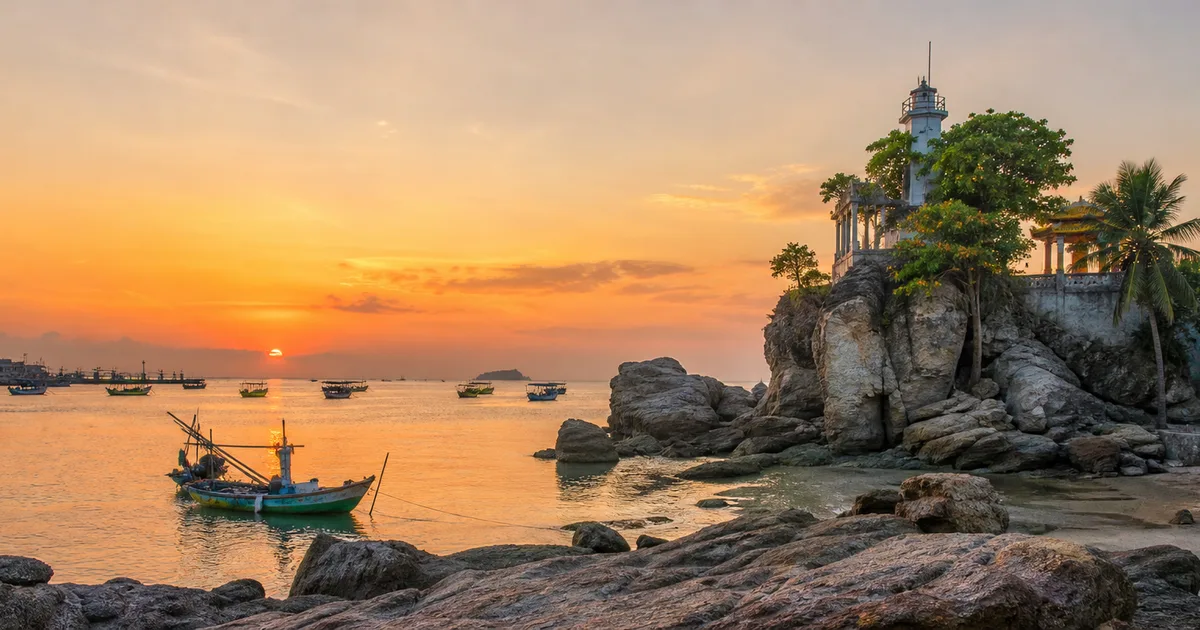
From Nguyen Du street to the rocks. Flat pavement the whole way.
Leave 25–30 minutes before sunset to catch the best light.
No entrance fee. Budget 20,000–30,000 VND for a coconut on the way.
Boats depart 5:00–5:45 PM. Sunset follows 30–60 min later.
How Do You Walk to Dinh Cau from the Duong Dong Guesthouse Area?
From our front door on Nguyen Du street, turn right and walk toward the river. You'll hit the riverside road — Bach Dang — in about two minutes. Turn left (north-west) and keep the water on your right. The path is paved, completely flat, and wide enough for two people side by side with room to spare. No motorbike chaos on this stretch; it's mostly pedestrians and the occasional food cart.
After about 500 metres you'll see the rock formation ahead of you, the small lighthouse on top, and the orange roof tiles of the temple shrine. The whole walk is 700–800 metres. At a normal stroll it takes 10 minutes. I've timed it many times because I always warn guests not to leave too late.
Along the way you'll pass a row of small food stalls and a juice cart that does excellent sugarcane juice (nuoc mia) for 15,000 VND. I always stop here on the walk back, not the walk there — going there you're racing the light, coming back there's no hurry.
The location page has a map of our street and the riverside path marked. If you get turned around, the lighthouse on the rock is visible from almost anywhere in this part of town.
What Exactly Is Dinh Cau, and Why Do Locals Care About It?
Built in 1937 on a natural granite outcrop right at the mouth of the Duong Dong river, Dinh Cau is a Taoist-Buddhist shrine dedicated to Thien Hau — the sea goddess who protects fishermen. The structure you see is modest: a small ornate gateway, incense urns, a shrine room with offerings, and a French-era lighthouse bolted onto the highest point of the rock. It's not grand architecture. That's not why people come.
For the fishing families of Duong Dong, this place is active and real. The incense is fresh most mornings. There are photos of boats and small plaques inside. When a boat is heading out for multiple days at sea, someone from the family often stops here first. I've never once seen it completely empty of locals, even at odd hours.
You can walk up to the shrine freely. No ticket, no guided tour required. If you go inside the shrine room, just dress reasonably — cover shoulders and knees, take off shoes. There's a donation box if you want to leave something. But you're also perfectly fine to sit on the outer rocks, watch the sea, and never go inside at all. Both happen constantly. Nobody minds either way.
See the FAQ page if you have questions about what activities are accessible near the homestay.
The Evening Fishing-Fleet Departure — What Does It Actually Look Like?
This is the part I find hardest to describe without sounding like I'm overselling it, so I'll just tell you what you see.
Starting around 5:00 PM, wooden fishing boats begin leaving Duong Dong port. The port is upstream, about 400 metres east of the rock. The boats motor slowly down the river, pass under the bridge, and come out through the estuary mouth right next to Dinh Cau. At that point they're 50–80 metres from where you're standing on the rocks. You can see the crew clearly. Some boats have two people; some have four or five. The nets are already stacked.
When each boat passes the temple, the engine slows. Not dramatically — just perceptibly. It's a brief thing. Some boats have a small shrine or incense holder near the bow that faces the temple as they pass. Then the engine picks back up and they're out to sea. The departure runs for 30–40 minutes, boat after boat. By 5:45 PM the main fleet is usually gone.
I've been watching this almost every week since 2018. I still stop to watch. There's something about seeing working boats leave for a night at sea, with the temple on the rocks and the sky going orange, that doesn't get old.
| Time | What's Happening | Best Spot |
|---|---|---|
| 5:00–5:45 PM | Fishing fleet departs through river mouth | Seaward rocks, western face |
| 20 min before sunset | Golden hour light on the lighthouse and temple | Rocks or 80 m east on the path |
| Sunset | Sun dips below sea horizon, sky turns deep orange-red | Seaward rocks facing west |
| 15–20 min after | Afterglow, boats visible on the horizon with lights | Anywhere on the rocks |
| By 6:30–7:00 PM | Night market in full swing 200 m away | Walk back along the river path |
The departures are less predictable during rough weather or the main fishing rest periods (check locally — there are regulated fishing moratorium periods in Vietnamese waters). But during normal conditions from May through January, the evening departure is reliable.
Where Should You Stand for the Best Dinh Cau Sunset Photos?
Two positions, depending on what you want.
On the rocks, western face. Climb the granite slabs on the seaward side of the outcrop — there's a clear path up. From here you can shoot back toward the lighthouse with the sunset sky directly behind it, or turn 90 degrees and frame the fishing boats passing with the orange horizon behind them. This is the classic shot. The rocks are flat enough to stand comfortably and the height (4–6 metres above water at low tide) adds a nice elevated angle.
From the riverside path, about 80 metres east. Step back from the rock entirely and you get the whole formation in frame — lighthouse, temple roof, rock base, and the wide river mouth. This is where I go when I want to show guests what Dinh Cau looks like as a place rather than from inside it. The light hits the orange temple roof tiles beautifully in the last 20 minutes before sunset.
A few practical notes on the rocks: some sections are slippery when wet or covered with algae at the lower levels. Flip-flops are fine on the upper slabs but take care on anything mossy. I've never seen anyone hurt, but I've seen a few phones dropped. Don't balance a phone on a rock ledge and walk away.
I should mention: the area gets crowded. On a clear evening in high season (November–March) there are easily 50–80 people on and around the rocks at sunset. It's not a secret. Go anyway. It's still worth it, and the crowd thins out fast once the sun is down.
When Does Sunset Actually Happen at Dinh Cau?
Phu Quoc is close enough to the equator that sunset times don't vary wildly across the year, but the difference between December and June is still noticeable enough to plan around.
| Month | Approx. Sunset Time | Sky Quality | Notes |
|---|---|---|---|
| November–January | 5:30–5:50 PM | Excellent — dry season clarity | Best months; leave homestay by 5:00 PM |
| February–March | 5:50–6:10 PM | Very good | Less crowd than peak season |
| April | 6:05–6:15 PM | Good, occasional haze | Transition month |
| May–August | 6:10–6:25 PM | Variable — clouds, but dramatic | Rainy season clouds = vivid colours |
| September–October | 5:50–6:10 PM | Often spectacular after rain | Wettest months; check the sky at 4:30 PM |
Rainy season sunsets are genuinely underrated. When a storm has just cleared, the post-rain sky over the sea goes colours I can't describe in a table. It's not consistent, obviously — sometimes it just stays grey. But when it breaks, it's extraordinary. I'd say half my favourite Dinh Cau photos were taken in October.
Check the current location and transport details for how to get around Duong Dong if you want to combine the sunset walk with an evening somewhere further out.
What Do You Do Right After Sunset at Dinh Cau?
The answer is almost always the same: walk 200 metres east and eat dinner at the night market. Cho Dem Dinh Cau opens at 5:00 PM and runs until about 10:30 PM. The sunset walk and the night market are designed for each other, even if nobody designed it that way. You come off the rocks, you're hungry, the market is right there.
The market is 200 metres from the rock along the same riverside path you walked in on. You'll smell it before you see it — charcoal grills and grilling scallops carry a long way in the evening air. The stall density is high and the atmosphere at 6:30–7:00 PM, when it's fully lit up, is genuinely lively. Grilled scallops with spring onion oil are 10,000–15,000 VND each. Squid runs 80,000–120,000 VND. See the full Phu Quoc food guide for what to order and current 2026 prices.
Alternatively, if you'd rather sit down for dinner away from the market noise, there are several small restaurants along Bach Dang river road on the walk back. Nothing fancy, plastic stools, hand-written menus — my kind of place. A full meal with a beer runs 80,000–120,000 VND per person.
One thing I'd skip: the coconut water carts near the rocks are fine before sunset, but the vendors sometimes charge 40,000–50,000 VND per coconut after dark when the tourist crowd peaks. The same coconut from a cart back on the main street costs 15,000–25,000 VND. Walk an extra 3 minutes.
Practical Tips Before You Head Out
None of these are complicated, but a few guests have asked the same questions often enough that I should put them here.
Footwear. Flip-flops work for the path and the upper rocks. If you want to go lower on the granite near the waterline, closed shoes with grip are better. Most people manage fine in sandals.
Dress for the temple. If you want to go inside the shrine room, cover shoulders and knees. Vietnamese religious sites are not strict about this with tourists but it's respectful and you'll notice that everyone who is actually praying there is dressed that way. For the rocks themselves, wear whatever.
Cash. Bring 30,000–50,000 VND for drinks and snacks from path vendors. Nothing near the rock accepts cards.
Mosquitoes. The river estuary at dusk. Apply repellent before you leave — this is a genuine recommendation, not a throwaway line. The path and the rocks themselves are usually fine in the wind off the sea, but the quieter spots near the mangrove edge on the walk there can be unpleasant without spray.
Combining with the market. If you plan to eat at the night market after, bring enough cash for dinner. A seafood feast for two at Dinh Cau Night Market runs 600,000–900,000 VND ($24–$36) including drinks. There's an ATM at the Agribank branch about 300 metres from the homestay if you need to draw cash before you leave. I can point you to it when you check in.
For everything else about getting around Duong Dong and the island, the transport guide covers motorbike rental, taxis, and what's actually within walking distance.
Stay 10 Minutes from Dinh Cau
Sabrina Homestay is a 10-minute flat walk from Dinh Cau rock temple. From $12/night. I'll give you the exact route when you arrive, and tell you what the sky looks like that evening. Check availability or message me directly.
WhatsApp Us →