Duong Dong River Walk at Dawn — Estuary Path from Night-Market Bridge to Dinh Cau
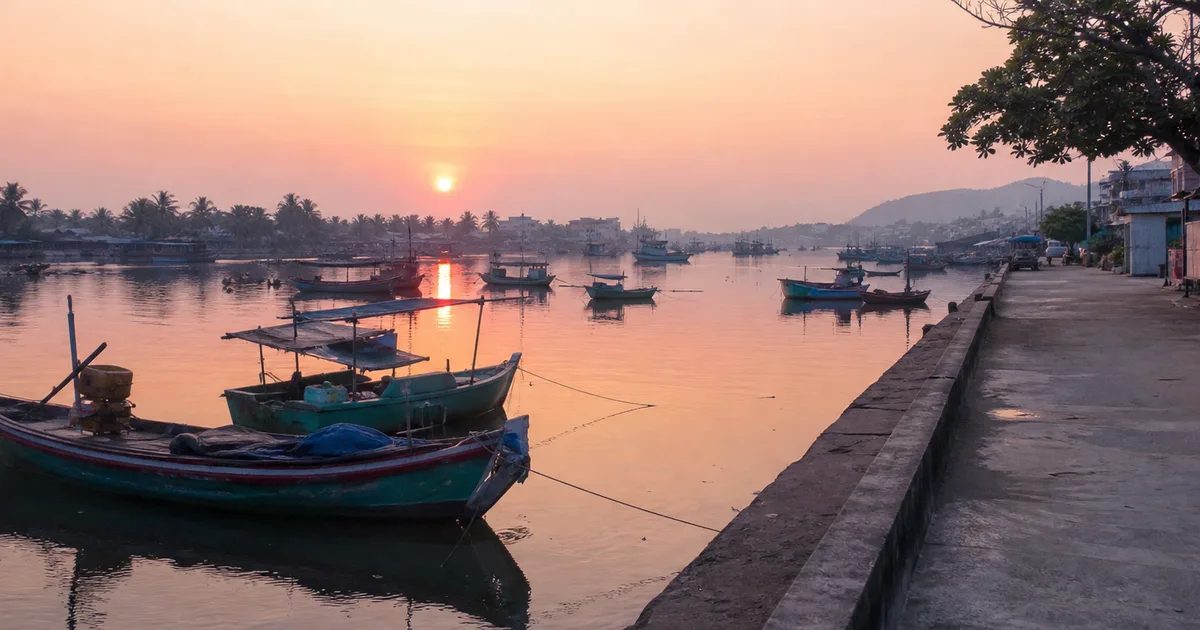
Most people sleep through the best 90 minutes Duong Dong has. Before the scooters start and the coffee shops open their shutters, the river estuary is already wide awake — fishing boats coming back in on the tide, ice being shovelled onto docks, cats lined up at the unloading ramp like small shareholders waiting for their dividend. This is the duong dong river walk at dawn phu quoc that I do two or three mornings a week, and it costs nothing except an early alarm.
- ~700 m riverside path, flat and paved, 10–15 minutes at leisure pace
- Start: night-market bridge on Bach Dang street (~350 m from Sabrina Homestay)
- End: Dinh Cau rock temple at the river mouth
- Peak boat activity: 5:00–5:45 AM (arrive by 5:15 AM for the best of it)
- Distinct from the sunset walk and the morning market — the river is the whole point here
- Good for early risers, photographers, anyone jet-lagged awake at 4:30 AM
What does the duong dong river walk at dawn phu quoc actually look like?
The Duong Dong river runs about 15 km from its source in the hills before it opens into the South China Sea at Dinh Cau. The estuary section you walk — from the night-market bridge to the river mouth — is roughly 700 metres of that. At night the river is dark and still, the boats motionless, the dockside empty. Around 4:30 AM that changes.
By the time I reach the night-market bridge — that's my starting point, about 350 metres from the homestay on Bach Dang street — I can already hear the low rumble of diesel engines coming in off the water. The sky isn't properly light yet. There's a grey-pink band along the horizon, and the lights of the boats make slow reflections on the river surface. The air smells like brine and wet rope and, underneath that, something faintly sweet that I've never managed to identify. Frangipani from somewhere up the bank, maybe.
From the bridge it's a straight 600–700 metres to Dinh Cau, following the western bank of the river as it widens toward the sea. The path is paved concrete the whole way — no navigation needed, no difficult terrain. At the 300-metre mark you hit the main dock area. That's where it gets interesting.
I've walked this route probably 200 times since I opened the homestay in 2018, and it's never exactly the same. The catch determines the mood. On nights when the boats come back heavy — squid season runs roughly October through March — there's real urgency to the unloading. Ice goes in, fish come out, mopeds loaded with polystyrene crates leave fast. On a slow night it's quieter, more unhurried. The fishermen sit on the dock drinking ca phe in small glasses and don't rush anything.
What time should you go for the dawn river walk?
Sunrise in Phu Quoc runs 5:45–6:00 AM from May through August, and 6:05–6:20 AM from November through February. The boats, though, don't wait for sunrise. Peak unloading at the estuary dock happens 5:00–5:45 AM regardless of season. If you sleep until 6:30 and then wander down, most of the action is already done — the dock is being hosed down, the boats are empty, and the cats have gone back to sleep somewhere in the shade.
My recommendation: set your alarm for 4:45 AM. Walk slowly, stop at the coffee cart near the bridge for a quick glass of hot ca phe (it's open by 5:00 AM, sometimes earlier — 15,000–25,000 VND), then carry on along the path. You'll arrive at the dock area around 5:15 AM, which is reliably the heart of it.
The pre-dawn light — that twenty-minute window before the sun actually clears the horizon — is the best light of the day for this walk. Not for dramatic sunset colours, but for the quality of it: soft, diffuse, slightly blue. The fishing boats are not romantic in the full morning sun. At 5:15 AM they look exactly like what they are, which is better.
| Season | Sunrise | Best walk window | Catch type |
|---|---|---|---|
| May–Aug (wet) | 5:45–6:00 AM | 5:00–6:30 AM | Mixed reef fish, some squid |
| Sep–Oct (transition) | 5:40–5:55 AM | 4:45–6:15 AM | Squid season begins, cuttlefish |
| Nov–Feb (dry, peak) | 6:05–6:20 AM | 5:00–6:30 AM | Heavy squid, mackerel, snapper |
| Mar–Apr (dry) | 5:45–6:00 AM | 5:00–6:30 AM | Varied, squid tailing off |
What actually happens when the fishing boats come in?
The boats that use the Duong Dong estuary dock are mostly small-to-medium wooden vessels — 8 to 15 metres long, painted in faded blues and greens, some with squid-luring lights rigged on horizontal poles that extend out over the water. They go out in the late afternoon, fish through the night, and come back before or just after dawn. The round trip is usually 15–40 nautical miles depending on where the fish are running.
When a boat docks, three things happen in quick succession. The catch gets iced down in the hold first if it isn't already. Then the polystyrene crates come up — two or three men passing them hand to hand from boat to dock. Then a buyer or a market trader who has been waiting on the dock opens the crates, does a quick inspection, and they haggle briefly or just nod. The whole transaction for a medium-sized catch takes maybe ten minutes. By 6:00 AM the serious buyers are already loading their mopeds and heading for the morning market, which is less than 500 metres away.
The cats know all of this. They arrive around 4:30 AM — sometimes six or seven of them, sometimes more — and position themselves at the base of the unloading ramp without any drama. The boat crew tosses them what doesn't sell: fish heads, small bycatch, occasionally a whole mackerel. One particular tabby with a torn ear has been at that dock every single morning since at least 2022. I stopped worrying about whether she eats well a long time ago.
If you want to see the estuary dock on a map before you go, it's marked as part of the Bach Dang waterfront. The FAQ page also has more general orientation notes for Duong Dong.
The route step by step: night-market bridge to Dinh Cau
The walk is straightforward. There is no way to get lost.
From Sabrina Homestay (Nguyen Du street): head north. The road curves slightly left after the first block — keep going. You'll cross a small intersection and then hit Bach Dang street, which runs parallel to the river. Turn left. The night-market bridge is immediately in front of you, roughly 350–400 metres from the homestay. Total walking time from the door: 4–5 minutes.
From the bridge: the riverside path begins here and runs north-west along the western bank of the Duong Dong river. You can see the river on your right immediately. The path is 2–3 metres wide, concrete, with a low barrier on the water side. At roughly 300 metres along, the dock area begins — this is where the boats tie up and where the unloading happens. Spend as long as you like here.
Continuing to Dinh Cau: another 300–400 metres past the main dock area the river mouth opens out and the path brings you to the Dinh Cau rock temple and lighthouse on the small promontory. Total distance from the bridge to Dinh Cau: 600–700 metres. At an easy pace with stops, allow 15–20 minutes.
At Dinh Cau in the early morning, the contrast with the sunset crowd is stark. No one is there. The temple is unlocked but quiet. You can stand at the water's edge and watch the light change over the South China Sea with nothing but the sound of the waves. It lasts maybe 20 minutes before the first motorbikes start passing and the day begins properly.
The Duong Dong morning market is a 5-minute walk back from the dock area if you want to continue from here — but that's a separate experience with its own rhythm, and worth a dedicated morning rather than tacking onto the river walk.
Does the season change what you see on the river?
Yes, noticeably. The dry season (November through April) is heavier for boats. Conditions are calmer, the South China Sea is more predictable, and the squid run well from October through March. That's when you'll see the most activity at the dock — sometimes eight or ten boats coming in close together, the dock loud and busy for a concentrated half-hour before it empties again. November and December are probably the best months to do this walk.
The wet season (May through October) sees fewer boats working overnight, and more coming in late morning instead. The dock is quieter at 5 AM but not empty — some crews fish year-round regardless of weather. June through August tends to bring rougher conditions and some grey, misty mornings that have their own atmosphere. The river looks wider when the sky is overcast. I find those mornings interesting, though guests usually prefer clear skies.
One thing that doesn't change: the cats. They're there every morning in every season.
The water level in the estuary rises and falls about 0.5–1 metre with the tidal cycle. At low tide some of the dock infrastructure is more exposed, and you'll see more of the boats' hulls above the waterline. At high tide the river surface is level with the dock decking and the boats sit higher. Neither is better for watching — just different.
What to bring for a 5 AM river walk in Duong Dong
Not much. Temperatures in Duong Dong at 5 AM run 24–27°C year-round — it's warm even before sunrise. Light clothes. The path is completely flat and paved, so any footwear works, though I wouldn't wear new white trainers near the dock.
The riverside doesn't have a bad mosquito problem, but near the water's edge in the wet season the still pre-dawn air brings a few out. A light spray on exposed skin takes thirty seconds and prevents an hour of annoyance — worth it.
Cash if you want coffee from the cart near the bridge — 15,000–25,000 VND for a glass of hot or iced Vietnamese coffee. They don't have card readers. Bring a phone for photos if you want them, but the low light before 5:30 AM means you'll need to shoot on a wide aperture or accept some blur. That's fine. Some of the best photos from this walk are blurred.
Nothing else is required. The walk takes 30–45 minutes total, including time at the dock. You'll be back at the homestay well before breakfast. Check-in at Sabrina Homestay is on Nguyen Du, which is almost exactly 400 metres from where the river path begins — one of the reasons I personally like this route so much.
Dawn walk vs. sunset walk at Dinh Cau — are they worth doing both?
They share the same destination but nothing else. Do both if you have time. The sunset walk to Dinh Cau is about the sea turning orange and the fishing boats leaving for the night — it's photogenic, there are other people around, and it runs directly into the night market which is 200 metres away. Natural sequence to an evening.
The dawn walk is a working river. It's not especially photogenic in a postcard sense. You're watching boats come in with a real catch, smelling diesel and fish, watching a cat negotiate with a fisherman over what's in the last crate. The town isn't performing for anyone at that hour.
| Dawn river walk | Sunset walk to Dinh Cau | |
|---|---|---|
| Best time | 5:00–6:30 AM | 25–30 min before official sunset |
| Crowd level | Almost empty | Moderate; busy in peak season |
| Main draw | Working fishing dock, river atmosphere | Sea light, rock temple, evening boats departing |
| After the walk | Morning market (separate morning, ~5 min away) | Dinh Cau Night Market (~200 m) |
| Duration | 30–45 min including dock time | 30–60 min |
| Season effect | Significant (dry season = more boats) | Mild (cloud cover affects light quality) |
A guest once told me she did the dawn walk on her first morning and the sunset walk on her last, and that those two experiences gave her more of a sense of what Phu Quoc actually is than any tour or beach day. I thought that was a fair reading. Check room availability if you want to plan your stay around both.
Stay 400 Metres from the River Path
Sabrina Homestay is on Nguyen Du street — less than 5 minutes from the night-market bridge where this walk starts. Rooms from $12/night. If you book with us, I'll tell you exactly where the early coffee cart is.
WhatsApp Us →