Fresh Fruit Stalls Duong Dong Phu Quoc — A Local Seasonal Guide
Every morning I walk the 700 m to Duong Dong Market to buy fruit before the heat sets in. After eight years of this, I know which stalls restock first, which vendor sells the sweetest rambutan in July, and exactly what to look for on a jackfruit when you cannot smell it through the plastic wrap. This guide covers the fresh fruit stall culture specific to Duong Dong — where the stalls are, what grows here versus what is trucked in, prices by the kilo for 2026, and a month-by-month table so you know what to look forward to whenever you arrive.
Peak for rambutan, mangosteen, mango, dragon fruit. Lowest prices of the year.
Widest selection, freshest stock. 700 m walk from Sabrina Homestay.
Most fruits 20,000–55,000 VND/kg in season. No bargaining needed.
Every vendor has a calculator. You do not need a single word of Vietnamese.
Where Are the Fresh Fruit Stalls in Duong Dong?
The main concentration is inside Cho Duong Dong (Duong Dong Market) on Nguyen Trai Street — the covered market hall and the open-air perimeter stalls that wrap around its south and east sides. From Sabrina Homestay at 16 Nguyen Du, that is roughly a 700 m walk north, about 9 minutes on foot. Mornings are the reason to go: vendors pile the tables with whatever came in overnight, and you can see clearly what is fresh versus what has been sitting since yesterday.
There is a second, more casual strip. A line of standalone fruit carts parks along Tran Hung Dao between the Dinh Cau roundabout and the long beach access road — probably ten or twelve carts depending on the day, some permanent, some seasonal. These are open longer hours than the market (roughly 7 AM to 10 PM) and skew toward easy-grab items: whole coconuts with straws already cut in, small bags of rambutan, pre-halved dragon fruit. Good for an impulse buy after the beach. Prices there run about 10–20% higher than the market stalls because of the location. It is not a scam; that is just the cost of being 200 m from the night market entrance.
A third cluster: a handful of fixed fruit stalls cluster near the entrance to the Duong Dong morning market on Bach Dang Street, running from around 5:30 AM. Those vendors sell more to local residents buying in bulk; the prices there are the lowest on the island, but selection by 8 AM is sometimes already thinned out.
For most guests staying with me, the Nguyen Trai market perimeter is the practical answer — it is walkable from the homestay, open until noon, and has enough variety to satisfy. See our location page for a map of the surrounding neighbourhood.
What Fruit Is in Season When? Month-by-Month Table
Phu Quoc sits at roughly 10° N latitude with a dry season (November through April) and a wet season (May through October). Most fruit peaks in the rainy season when heat and humidity are highest. Below is my honest month-by-month summary based on what I actually buy, not what the tourist brochures claim. Prices are 2026 market stall ranges in VND per kg.
| Month | Best fruits available | Notes & price range (VND/kg) |
|---|---|---|
| Jan | Star apple (vu sua), longan, pomelo | Star apple peaks — 40,000–70,000 VND/kg. Imported mango available. |
| Feb | Star apple, watermelon, longan | Tet period: prices spike briefly, then settle. Watermelon 15,000–25,000 VND/kg. |
| Mar | Watermelon, jackfruit (early), pineapple | Jackfruit starts appearing; young green ones for cooking, yellow ones for eating raw. Pineapple 20,000–35,000 VND/kg. |
| Apr | Dragon fruit, mango (first wave), jackfruit | Dragon fruit starts dropping in price. Red-flesh variety 30,000–55,000 VND/kg. |
| May | Dragon fruit, mango, rambutan (early), mangosteen | Mango floods in — local small variety 25,000–40,000 VND/kg. Mangosteen arrives 40,000–65,000 VND/kg. |
| Jun | Rambutan, mangosteen, mango, dragon fruit | Best month overall. Rambutan 15,000–30,000 VND/kg. Mangosteen peaks. |
| Jul | Rambutan, mangosteen, jackfruit, durian | Durian season on the mainland reaches Phu Quoc — 80,000–150,000 VND/kg. Strong smell; buy and eat outside. |
| Aug | Rambutan, sim berries (fresh), longan, jackfruit | Sim berries briefly sold fresh at the market — rare, 50,000–80,000 VND/100g. Rambutan still plentiful. |
| Sep | Longan, pomelo, dragon fruit (second wave) | Wet season peaks; some fruit is waterlogged and less sweet. Pomelo 30,000–50,000 VND/kg. |
| Oct | Pomelo, dragon fruit, guava | Dragon fruit prices climb slightly as the rainy season winds down. Guava 20,000–35,000 VND/kg. |
| Nov | Star apple (new season), longan, guava | First star apples of the season — green-skinned, creamy inside, best on Phu Quoc, 45,000–75,000 VND/kg. |
| Dec | Star apple, longan, watermelon, imported citrus | Dry season sets in; prices for imported fruit drop as mainland supply improves. |
Prices are 2026 Duong Dong market ranges. Seasonal windows shift by 2–3 weeks year to year depending on rainfall. The table covers what I personally buy at the market; imported fruit from the mainland is available year-round at higher prices.
A few things worth knowing about this table: "available" does not mean "worth buying." September dragon fruit is often watery from the heavy rains. July durian is genuinely excellent if you like durian, but half my guests do not and the smell lingers. January star apple is the single best reason to visit in the dry season, and it is completely unknown to most foreign visitors.
The Main Fruits — Prices, How to Pick Them, What to Expect
Dragon Fruit (Thanh Long)
Two varieties at the Duong Dong stalls: red-fleshed (ruot do) and white-fleshed (ruot trang). The red-flesh variety is sweeter, slightly more expensive, and noticeably better. Ripe fruit has bright, evenly coloured skin — vivid pink-red with green fins. The fins should feel slightly soft at the tips, not bone-dry or brown. Press the skin gently: give a little, like a ripe avocado, not a rock. White-flesh dragon fruit: 20,000–40,000 VND/kg. Red-flesh: 30,000–55,000 VND/kg in season, up to 70,000 VND in the dry months.
Rambutan (Chom Chom)
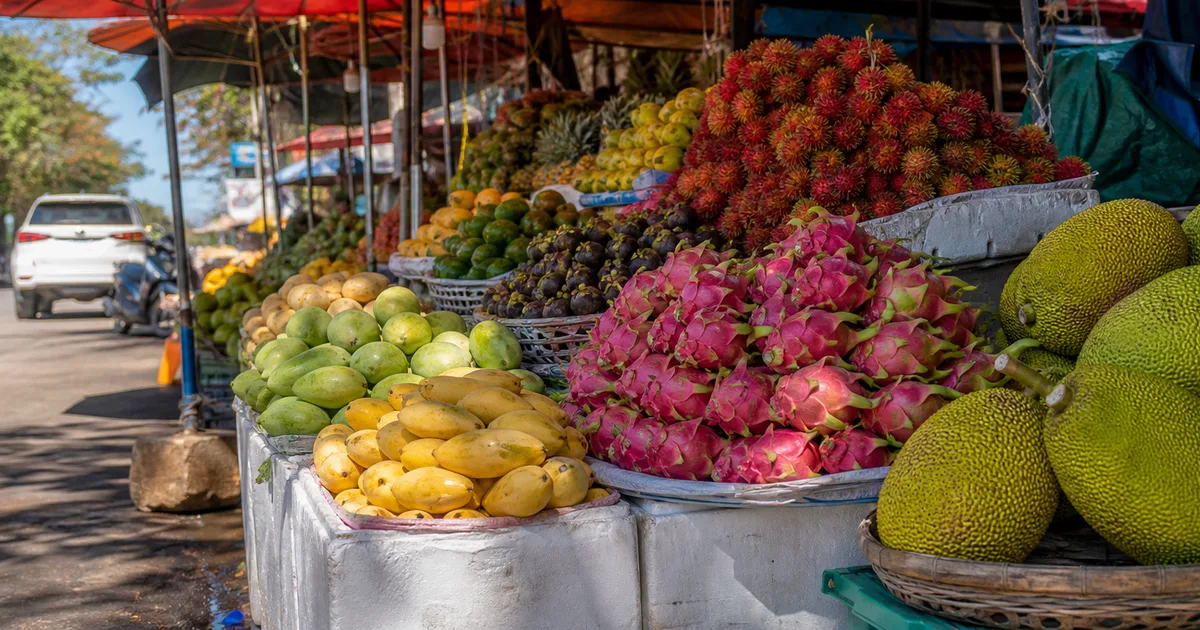
The peak is June and July, and that is when the stalls almost overflow with them — piled in big red-yellow heaps, 15,000–30,000 VND/kg. Look for fruit where the hair-like spines are still supple and greenish at the tips, not dry and dark. If the skin is starting to blacken or the spines snap off rather than bend, it is past its best. Buy two. You'll wish you had.
Jackfruit (Mit)
Sold in three ways: whole (enormous, 5–20 kg), pre-split into segments and bagged, or as individual pods already shelled. Whole jackfruit runs 15,000–30,000 VND/kg; pre-cut pods are roughly 50,000–80,000 VND per bag at market stalls (much more convenient for a short stay). Picking a ripe one: press your thumbnail into the skin — slight give, not rock-solid. A sweet, faintly fermented smell means it is ready. If in doubt, hold up one finger; the vendor will slice a single segment for you to taste. This works every time and no one minds.
Mango (Xoai)
Several varieties show up at Phu Quoc stalls. The small, oblong local type (xoai cat) peaks May through July, is intensely sweet, and costs 25,000–40,000 VND/kg when abundant. The larger green-skinned xoai tuong is eaten unripe with salt, chili, and fish sauce — a completely different and excellent experience available most of the year. For ripe eating mangoes, look for smooth skin with a slight blush, give under gentle pressure, and a faint sweet smell at the stem end. An unripe mango will sit on your counter for two or three days and ripen nicely if you bought it green.
Mangosteen (Mang Cut)
Short season, disproportionate reward. May through August, peaking in June–July. The outer shell should be deep purple-brown, firm but not rock-hard, with the green cap still intact. Crack it open: the segments inside should be white and plump, never brown. Vendors usually have a broken one open on the counter for display — that is the honest signal of quality. Price: 40,000–70,000 VND/kg at peak. Outside season, imported mainland mangosteen is available but visibly less vibrant; it is still fine, just not transcendent.
Longan (Nhan)
Available in clusters on the branch, which tells you they are fresh. Skin should be light brown and intact, no cracks or mould. The flesh inside is translucent white, sweet, and slightly floral. Good longan costs 30,000–50,000 VND/kg. A simple fruit for snacking; easy to peel, seed small. Widely available from June through January with a gap in the very hottest months.
Star Apple (Vu Sua)
The most underrated fruit on Phu Quoc and almost entirely unknown to foreign visitors. The Phu Quoc green-skinned variety is different from the purple mainland type: the flesh is white and almost custardy, very sweet, with a slight milkiness that gives the fruit its name. Season runs November through February. Squeeze gently — ripe fruit has a little give all over. Do not refrigerate; it turns the flesh bitter. Price: 40,000–75,000 VND/kg. If you are here in December or January and have not tried one, that is a real omission.
For more context on where fruit fits into a full Duong Dong eating day, the Phu Quoc food guide covers the broader picture, and eating under $5 in Duong Dong covers how to build a cheap and good meal around market produce.
How Do You Actually Buy Fruit Without Any Vietnamese?
The short answer: you do not need any Vietnamese at all. This is a transaction that runs on pointing, a calculator, and basic hand signals, and it works smoothly at every market stall and roadside cart in Duong Dong.
The sequence: walk along the stalls, stop at what interests you, point at the fruit clearly. The vendor will either hold it up for you to smell or tap a small scale. Hold up fingers for the number of kilos you want — one, two, half (hold thumb and forefinger close together). They weigh it, punch the total into a calculator, and turn the screen toward you. You pay and get change. That is everything.
A few practical notes. If you want to taste something before committing to a kilo, point at the fruit, then point at your mouth. Almost every vendor will comply — they cut a tiny sample, not the whole thing. For jackfruit specifically, hold up one finger as a signal for "just one segment please." For pre-cut fruit in bags, the price is usually written on a small tag already.
Bargaining: the Duong Dong market is not a bargaining culture for fruit. Prices are set, not inflated for tourists. The difference between what I pay and what a first-time visitor pays is essentially zero at the stalls inside the market. The outdoor cart strip near Tran Hung Dao does sometimes nudge prices up for obvious tourists; you can decline, walk to the next cart, and the price will be the same or lower. It is not worth any stress.
See our FAQ page for more practical questions about getting around Duong Dong on foot.
When Is the Best Time of Day to Go?
Arrive between 6:30 and 9:00 AM. That window hits the right combination: vendors have restocked from the overnight arrivals, the air is still bearable, and the whole market has a specific morning energy that feels completely different from the midday version. By 10 AM the heat inside the covered hall becomes real, cut fruit starts attracting flies, and the better stuff has sold. I am usually there by 7:15, done by 8:00.
The Tran Hung Dao roadside carts are open much later — some run until 10 PM — and are a perfectly good option for an evening coconut or a quick rambutan buy after dinner. They are not restocked continuously through the day; by afternoon the selection is whatever has not sold since morning. That is fine for hardy fruit like dragon fruit or jackfruit, less ideal for rambutan or mangosteen that turn quickly.
Sunday mornings are the busiest at the main market. Not overwhelming, but the perimeter stalls get crowded and service slows. If you are new to the market and want a calm first visit to get your bearings, go on a Tuesday or Wednesday.
The full Duong Dong morning market walk guide covers the broader market experience — not just fruit, but the fish section, the herb sellers, the banh mi stalls at the entrance.
Fruit That Actually Comes From This Island
A lot of what you see at Duong Dong fruit stalls is trucked in from the Mekong Delta and the southern mainland — perfectly good, but not locally grown. These are the exceptions: things that either originate here or are grown in the island's interior to a quality you will not find on the mainland at the same price.
Phu Quoc Green Star Apple (Vu Sua Xanh)
The island's most distinctive fruit. Green-skinned when ripe (this surprises most people), almost custardy flesh, a sweetness with a faint milky quality. The trees grow in the northwestern part of the island toward Cua Duong village. Season November–February. Forty or fifty years ago this was a major local product; now there are fewer trees and the market has more mainland competition, but the ones you find at Cho Duong Dong from local growers in November and December are still worth seeking out specifically. Vendors who sell the Phu Quoc variety sometimes keep them separate from the mainland purple ones — look for the green skin and ask to smell.
Sim Berries (Qua Sim)
Available fresh for a narrow window in August and very early September at a small number of stalls. Small, dark purple, intensely tart-sweet, similar in texture to a blueberry but more fibrous. The stalls that have them are not easy to spot — look for dark purple fruit in small baskets near the dried-goods section of the market. Price: 50,000–80,000 VND per 100 g. Most visitors know sim only as sim wine; eating the fresh berry is a different and worthwhile thing. They also sell dried sim berries year-round, which keep for weeks.
Local Coconut (Dua Tuoi)
Phu Quoc grows its own coconuts; you see the palms everywhere from the road. The young drinking coconuts at market stalls are not necessarily from the island itself (many come from Ben Tre province on the mainland), but the taste is excellent and the price is fair: 10,000–20,000 VND for a whole coconut with straw at the market, 20,000–30,000 VND on the Tran Hung Dao carts. Buy from the market stalls for best value. The vendor will chop the top off in about four seconds flat.
Guests staying in our rooms who want to cook with fresh market ingredients have access to the shared kitchen. A basket of in-season fruit from the morning market — rambutan, dragon fruit, one or two mangoes — costs under 80,000 VND and handles breakfast for two people without any cooking required.
Stay 700 m From the Market — Walk It Every Morning
Sabrina Homestay is a 9-minute walk from the Duong Dong market fruit stalls. Shared kitchen available. From $12/night.
WhatsApp Us →