Long Beach Phu Quoc Duong Dong Walking — Free Entry, Sunset Timing & the Quiet Stretches
Long Beach — Bai Truong — runs almost 20 km down Phu Quoc's western coast, but you don't need a motorbike to reach a good stretch of it. From guesthouses in the Duong Dong area, the northern 3 km of Long Beach is on foot. This guide covers the exact access lanes, which operators charge for chairs and which patches of sand are genuinely free, how the crowd density shifts as you move south along the shore, and when to show up for the sunset. I walk here two or three times a week.
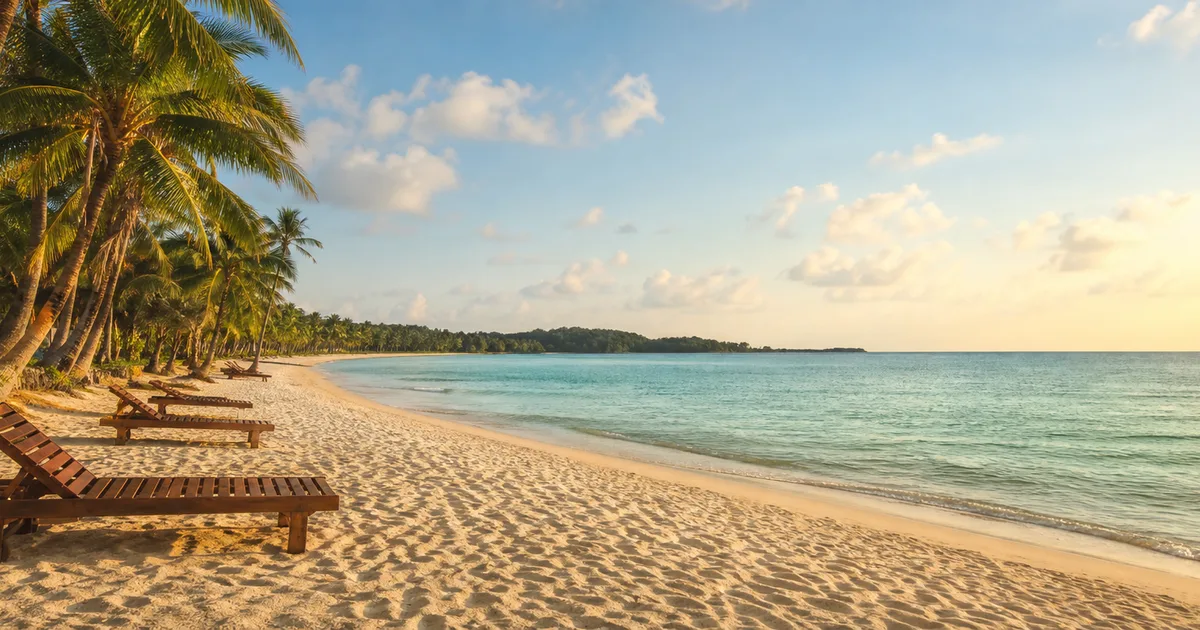
Nearest sand from Sabrina. No transport needed.
Open public stretches with no chair pressure.
Per chair at beach bars. Free with drink order at some.
Seasonal range. Faces the South China Sea directly west.
How Far Is Long Beach from the Duong Dong Guesthouse Area?
The nearest sand on Bai Truong is about 700 m from Sabrina Homestay on Nguyen Du street — roughly 9 minutes if you walk at a normal pace. Head west on Tran Hung Dao (the main road through town), then turn left down any of the beach-access lanes that cut between the guesthouses and budget hotels facing the shore. You'll know you're on the right track when the pavement narrows and you can smell coconut sunscreen.
The full northern walkable stretch — from the access point near the old Dinh Cau lighthouse area down to where the bigger resort cluster starts — is about 3 km of coastline. Most of that is accessible on foot from town. I've done this walk enough times to know it by feel: around 35–40 minutes if you go all the way to the quieter southern end of the northern stretch without stopping. See the location page for a map of Sabrina relative to the beach access.
One thing guests often ask: is there a specific beach entrance, like a gate? No. The northern end of Long Beach doesn't work like that. You simply walk down an access lane between buildings until you hit sand. There are several of these lanes between guesthouses along Tran Hung Dao, spaced roughly every 200–300 m. Most are unmarked. The one I use most often is about 800 m from here — it comes out directly onto open sand rather than into a beach bar's seating area.
Where Are the Free Entry Points to Long Beach from Duong Dong?
The public access lane beside the old Tropicana Beach Club site (it closed a few years back, the plot is fenced but the lane beside it remains open) off Tran Hung Dao leads directly to open sand. No gate, no fee, nobody trying to sell you a chair. That access lane is about 800 m from Sabrina on foot. I've been using it since 2018 and nothing has changed.
There's a second good access point roughly 300 m further south — a narrow lane between two small guesthouses with a faded "Beach" sign at the street end. That one also drops you directly onto the open public sand between two beach bar concession areas. During the dry season you'll see locals fishing off that stretch in the early morning. The sand is wider there, too, maybe 25–30 m from waterline to the vegetation line, compared to 15–18 m closer to the Dinh Cau end.
Worth noting: none of the access lanes I use are secret or hidden. They're just not obvious from the main road because there's no English signage. Any local will point you down the right lane if you ask "beach?" and gesture west. See our food guide for the broader Duong Dong orientation if you're just arriving.
Which Sun-Lounger Operators Charge — and Which Sections Are Free?
This is the question I get asked most often when guests come back from their first beach walk. The answer is messier than a simple yes/no.
Beach bars with their own concession areas — and there are six or seven of them along the northern 3 km — typically charge 50,000–100,000 VND per chair, sometimes per pair of chairs. A few waive the fee entirely if you order at least one drink (a coconut water or beer is usually enough). The best approach is to ask before you sit. "Is there a fee?" works fine; most bar staff speak enough English to answer directly.
Between concession areas — and there are real gaps between them — the sand is genuinely public and you can spread a towel or mat with no charge and no pressure. The vendors who walk the beach selling fruit, drinks, and massage services will approach you regardless of where you sit, but they are not aggressive. One "no thank you" is enough. I've never had a problem.
| Zone Type | Chair Cost (VND) | Drink Required? | Typical Pressure? |
|---|---|---|---|
| Beach bar concession area | 50,000–100,000/chair | Sometimes waived with 1 drink | Low — staff are polite |
| Resort-attached lounger area | 100,000–150,000/chair | Usually yes, minimum spend | Low if you're a paying guest |
| Open public sand between operators | 0 | No | Walking vendors only, easy to decline |
| Far southern end of northern stretch | 0 | No | Almost none past the resort cluster |
If you're price-conscious and want a sun-lounger, the beach bars that do the "free with a drink" deal are better value than you'd expect — a Saigon beer or fresh coconut runs 30,000–50,000 VND, which is what you'd pay at any street stall. You're effectively getting two chairs for the price of two drinks. That's reasonable. See the pricing page for other Duong Dong cost benchmarks.
Where Is It Quiet and Where Is It Busy Along the Northern Long Beach?
The section right at the northern tip — within 500 m of the Dinh Cau rock end — is the most crowded, especially from 10:00 to 15:00. A cluster of beach bars sits there, the sand is narrower, and you're within sight of the Dinh Cau lighthouse so tourist groups turn up on foot or by xe om. It's not unpleasant, but it's not what I'd call a quiet beach afternoon.
Walk 1.5 km south from that northern access point and the character of the beach changes. Fewer bars, wider sand, more space between sunbathers. This stretch — roughly 1.5 to 2.5 km south of the Dinh Cau area — is where I go when I want to actually sit and read without someone offering me a massage every 12 minutes. The vendors still walk through but less frequently.
Past the 2.5 km mark you start hitting the bigger resort frontages — the hotels with their own beach concessions, sunbeds lined up in rows. It's well-maintained and the sand is clean, but the public character of the beach diminishes. For most guests staying near Sabrina, the sweet spot is between 1 and 2.5 km south of the nearest access lane. That's still fully walkable — around 20–30 minutes from the homestay.
Time of day matters as much as location. Before 09:00 the northern stretch is quiet everywhere — mainly locals exercising, a few fishermen. After 15:00 the tour groups thin out. Midday (11:00–14:00) is when it's most active and also when the sun is genuinely punishing. Check the Dinh Cau sunset walk guide if you want to combine a late-afternoon beach walk with sunset at the temple — it's an easy loop.
What Time Is Sunset on Long Beach and Where Should You Stand?
Long Beach faces almost due west, directly into the South China Sea. Sunset here is the real thing — no hills blocking the horizon, the sun drops into the water cleanly. The timing shifts through the year: roughly 18:00–18:20 from November through February, and 18:30–18:50 during the May–September period. You can check the exact time for any date on a weather app, but the range above covers 95% of the year.
Arrive at the waterline about 20 minutes before the listed sunset time. The sky's colour typically builds fast in the last 15–20 minutes and peaks for maybe 8–10 minutes after the sun itself disappears. If you're still walking down the beach when it starts, you'll miss the best light. I've made that mistake more times than I want to admit — left the house too late because I got distracted answering a booking message.
Where to stand is a matter of personal taste. The northern access point near the Dinh Cau end gives you a view of the lighthouse silhouette to the north, which photographs well. The cleaner, more open sunset view — nothing on the horizon, just sea — is from the quieter 1.5–2.5 km section. Both are good. The open-sand sections have no benches or fixed chairs, so either bring something to sit on or plan to stand at the waterline, which honestly is the better choice anyway. The walk back to Sabrina takes about 12–15 minutes in the dark, so bring a charged phone for the torch function. Our FAQ page has notes on evening safety in Duong Dong.
Is It Safe to Swim on the Northern Stretch of Long Beach?
Dry season (November through April): yes, comfortably. The water on the northern Long Beach stretch in those months is calm, warm, and clear. Waves stay well under 0.5 m. You can wade out 50–100 m in places and it stays chest-deep. My guests from cold countries are usually surprised by how swimmable it is — there's no undertow on the northern stretch that I've ever noticed, and the bottom is sand with no rocks.
Wet season (May through October): it varies. The southwesterly monsoon hits the western coast directly, and on windy days the chop makes swimming less comfortable rather than genuinely dangerous. Waves reach 0.5–1 m and the water muddies slightly. I wouldn't call it dangerous for a competent swimmer, but it's not a relaxing float. The beach itself is still fine for walking and sunset-watching — the weather tends to clear dramatically in the evenings even during wet season, which produces some of the most saturated sunsets of the year.
One practical note: there are no lifeguards on the public sections of Long Beach north of the resort cluster. If you're swimming with children, stay in the shallower water (thigh to waist depth) and keep them close. For a family booking, mention you have small children and I'll point you to the calmer, more sheltered stretch I use.
Northern vs. Central Long Beach — What's the Actual Difference?
Guests who've done some research before arriving often ask whether they should take a motorbike down to the mid-beach resort area for a "better" beach experience. Here's my honest answer.
| Factor | Northern stretch (walkable) | Central/mid-beach (15–20 min ride) |
|---|---|---|
| Distance from Sabrina | 700 m–2.5 km on foot | ~6–10 km, need transport |
| Sand quality | Fine, slightly coarser near rocks | Fine throughout, very consistent |
| Crowd level (10:00–15:00) | Moderate near north, quiet mid-stretch | Busier — resort guests plus tours |
| Free spots | Yes, clearly defined gaps | Less common — more resort frontage |
| Facilities (toilets, showers) | At beach bars, cost of a drink | Better — resort facilities, some public |
| Sunset quality | Excellent — open horizon | Excellent — same beach, same sky |
| Transport needed | No | Yes — motorbike or taxi |
The honest truth: for an afternoon swim and sunset, the northern walkable stretch does everything the central section does, and you skip the transport cost (40,000–80,000 VND each way by xe om or Grab). The sand quality difference is real but small — the central section is marginally finer and more consistent. Whether that's worth a 15 km round trip is your call. For most guests who stay 3–5 nights, I'd say walk the northern section twice, then one afternoon do the motorbike trip south to see the difference. You'll probably decide the northern stretch is plenty.
Book a room at Sabrina and the beach is on your doorstep. That changes how you use it — instead of one planned beach day, you end up going four evenings in a row because it costs nothing and takes nothing to get there.
Stay 700 m from Long Beach
Sabrina Homestay is the closest budget guesthouse to the northern Long Beach access lanes. Rooms from $12/night, kitchen included.
WhatsApp Us →